Roadside investigations of psyllids, ants and eucs
I was driving down a country highway on the 25th of October, in the late afternoon sun. One of the better things to do when driving is a bit of drive-by botany. Honestly it's hard to ignore for me. I couldn't help but notice that all the new River Red Gums recruits appeared to be dead or dying.
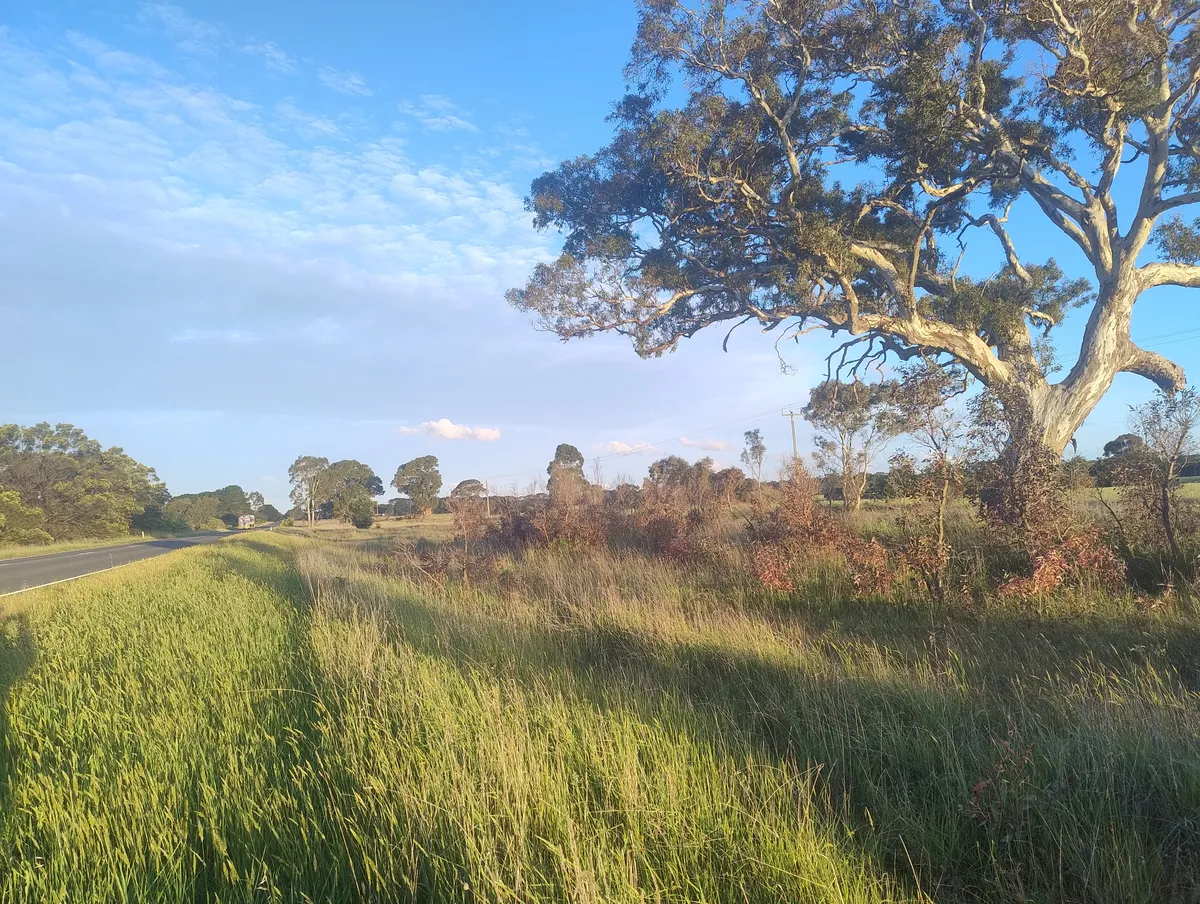
When I use the term 'recruits', its a shortening for the word 'recruitment'. And recruitment in this context is the process by which new individuals of a particular plant species are added to an existing population. In my case this was the collective group of young River Red Gums Eucalyptus camaldulensis, the seedlings/saplings and immature trees. All of which self-seeded and surrounded the older parent tree. There can even be a 'recruitment cohort', where all the recruits are of a similar age to one another.
In some species recruitment is a continuous process, with new recruits germinating every spring. Some will survive and others will perish. In other species recruitment can be episodic, relying on a specific event to occur. In the Australian landscape, fire is commonly required (e.g. in Eucalyptus regnans, the bradysporous Banksia species, etc.). In River Red Gums, periods of flooding are super important for the long-term persistence and recovery of populations at the landscape scale.
But what is causing the death of all these River Red Gum recruits?
Doing roadside botany is nice, but there is only so much that can be gained traveling past at 110km/h. Anyway, I decided to actually stop and get a closer look:
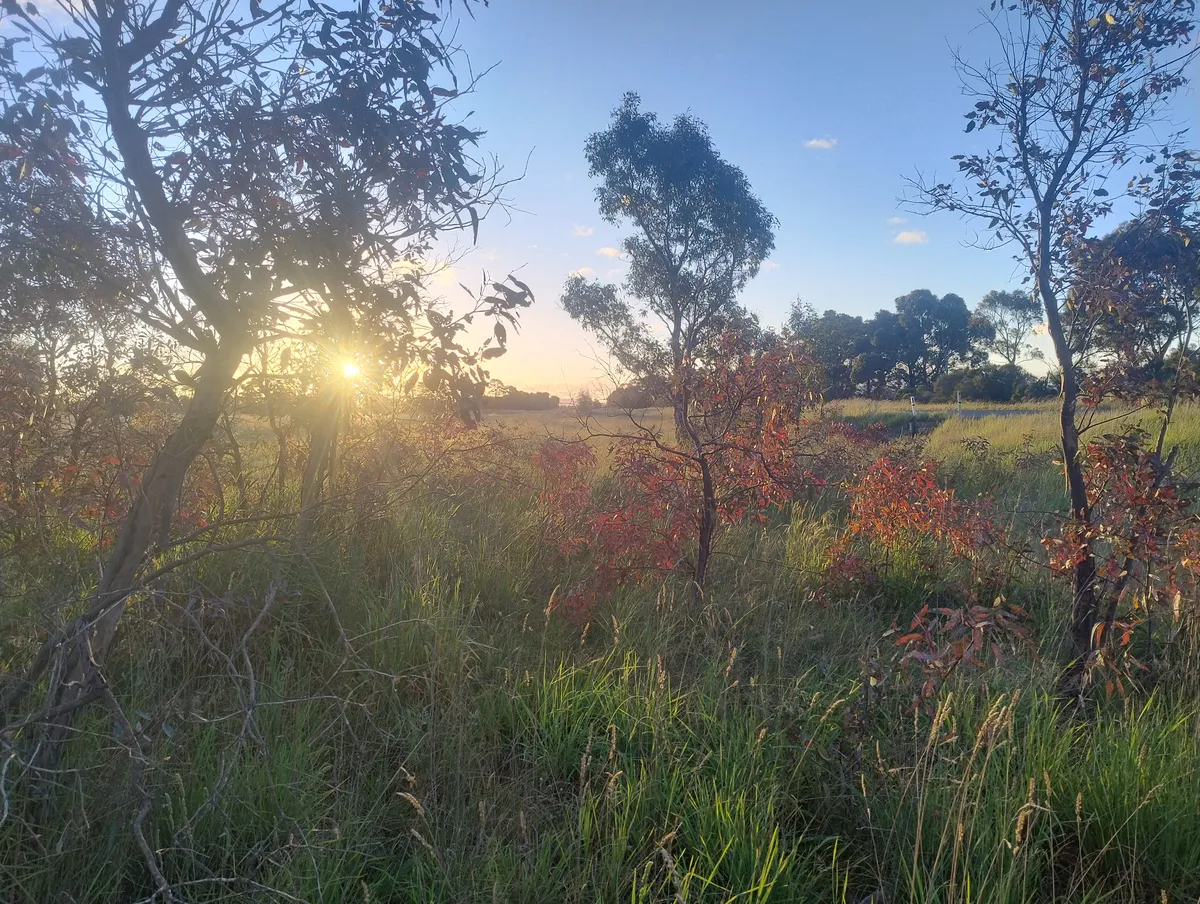 I initially thought maybe the recent hot weather, but then again, we haven't even started summer and the dry spells haven't even lasted that long - maybe a week max. Further, the death and damage seemed to only affect River Red Gums.
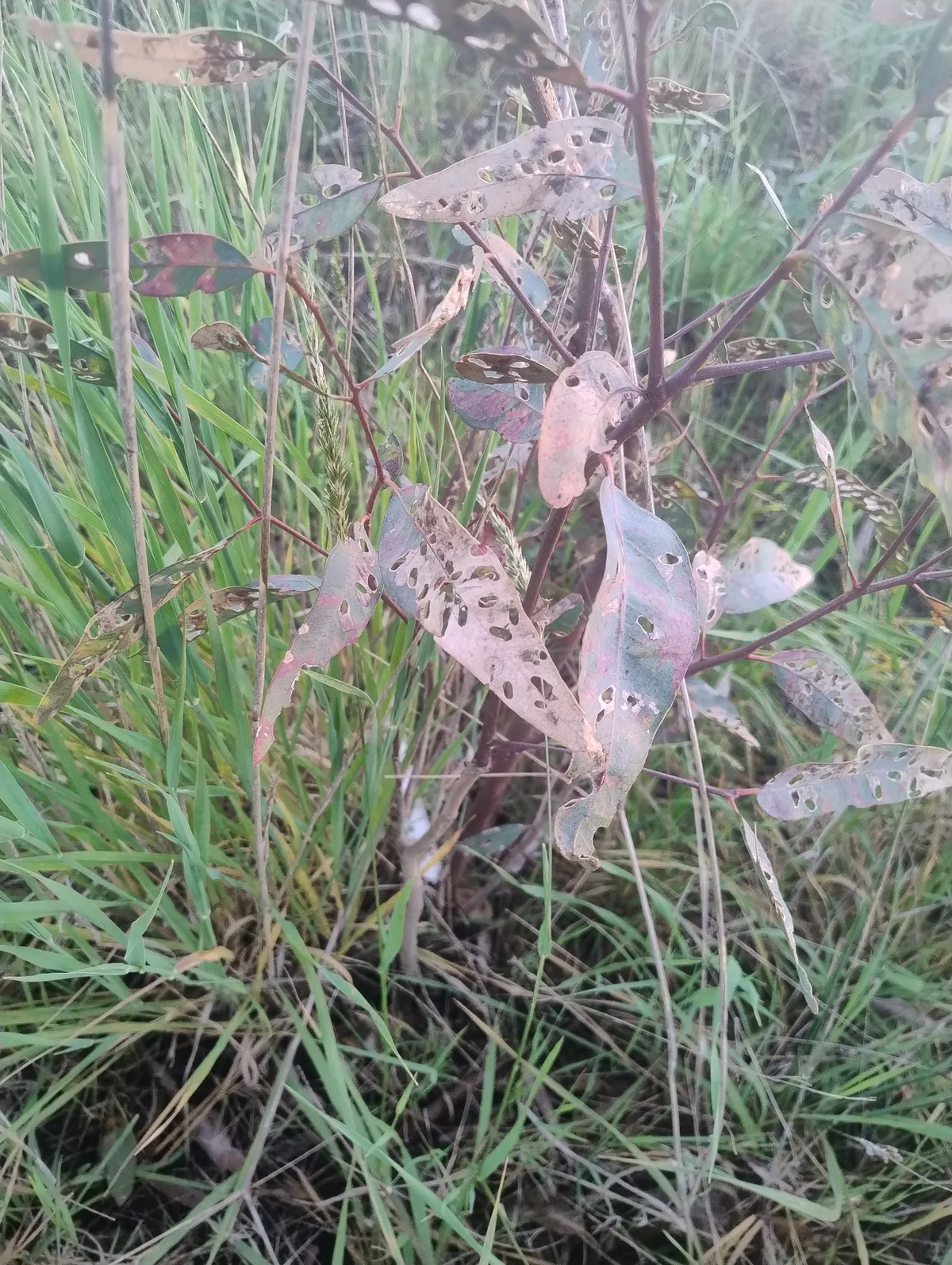
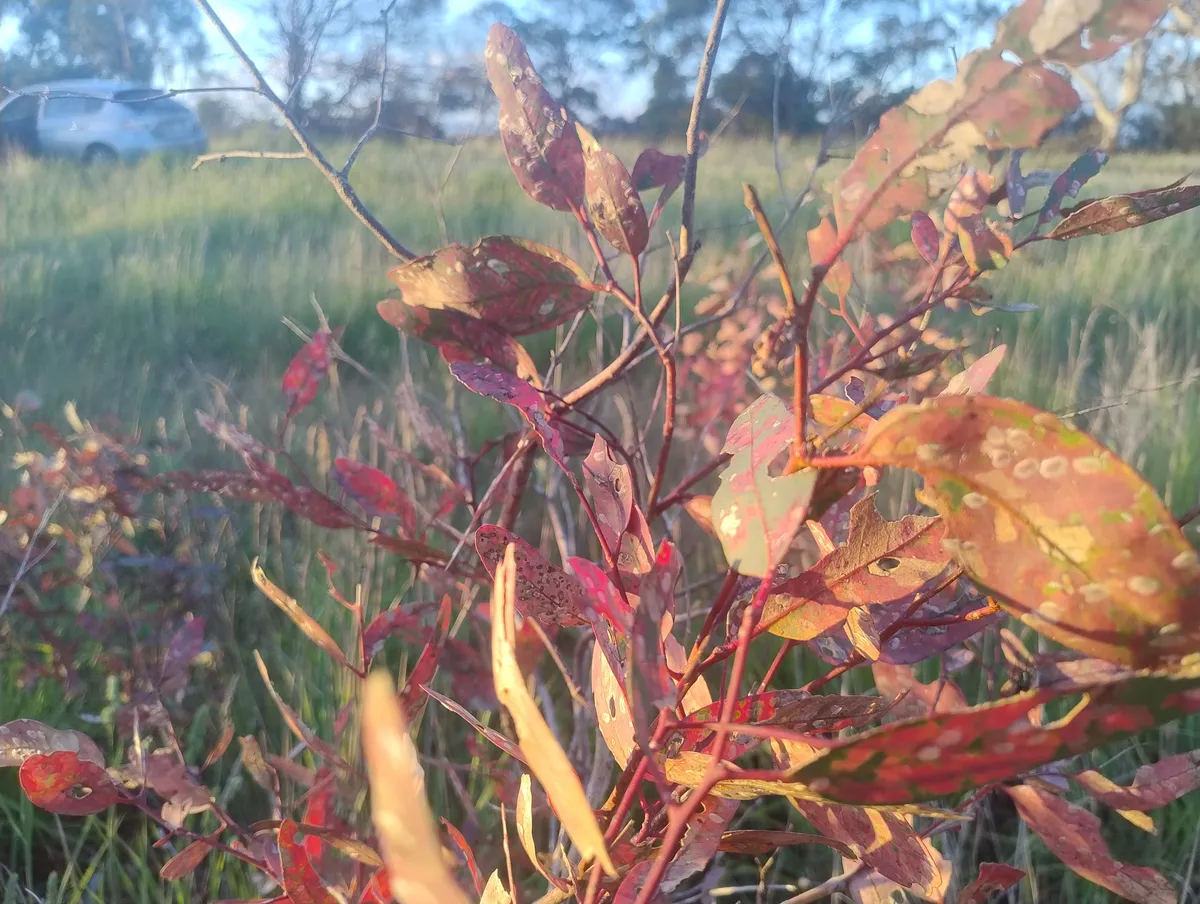 Immediately on closer inspection, it was obvious another cause was behind all the dead young recruits. All the leaves are battered, purplish - reddish, browning and full of holes.
What sort of insect herbivore caused this - and why are ants crawling all over these trees??
After some research, I discovered that multiple different insect herbivores could be responsible. For instance, the holes can be from the larvae of the leaf-mining leafblister Sawfly Phylacteophaga froggatti, or even the larvae of cup moths Doratifera sp..
However, one candidate truly stood out amongst the rest. An insect herbivore that made sense in the context of everything else I saw.
The recruits are suffering damage from a psyllid attack and I believe likely a species in the genus Cardiaspina, although a Glycaspis sp. is also possible.
If you look carefully in the upper-most leaf axil, you can even see a psyllid in nymph form!
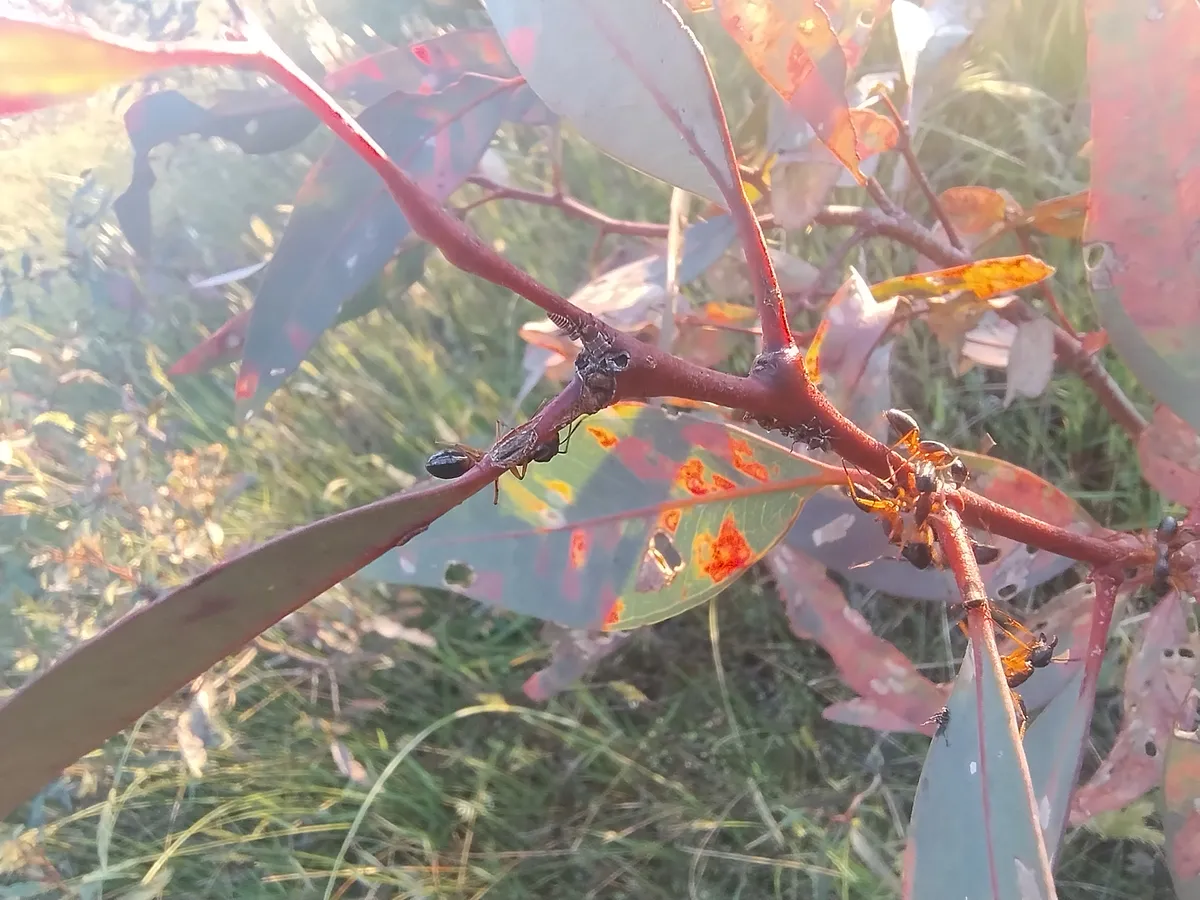
The other reason I am fairly confident its a psyllid is due to so many ants being in the canopy of these trees.
Psyllids and meat ants
Psyllids are insects from the family Psyllidae in the Order Hemiptera. They are all plant-feeding insects and are usually host-specific. Multiple psyllids use Eucalyptus camaldulensis as a host plant. Over a matter of weeks, a psyllid will hatch from an egg, advance through five nymph stages (or instars), each quite different morphologically, before finally reaching adulthood. Late stage nymphs have small forewings that develop fully once an adult.
Lerp-building psyllids (not all species, but many in Australia are) will construct either soft or hard coverings called lerps of various designs and sizes beneath which the immature nymphs shelter and feed.
These nymphs also secrete a sugary fluid, called honeydew that all these worker ants harvest for themselves. The benefit to the psyllid however is protection. The ants will protect them from many different predators, including many bird species.
Now to the ants I discovered. They are from the genus Iridomyrmex aka the meat ants1. I'm not sure the species, possibly Iridomyrmex purpureus. They are highly aggressive and territorial ants, that are so versatile. As a generalist scavenger, worker ants will climb trees in search for these psyllids, to then rob them of their honeydew.
But why did this psyllid outbreak occur now?
There has been, quite possibly still is, a debate on if herbivorous insect populations are regulated by a top-down or bottom-up effects. Are insect population densities influenced by food supply (the plant leaves and their chemistry) or by the action of natural predators? To be honest, I am out of my depth here... I don't even want to speculate on the matter.
However, upon reading Simon Leather's excellent blogpost, and also some papers specific to insect herbivory in Eucalyptus camaldulensis, I believe the psyllid outbreak was due to a bottom-up effect. I think it's the plant chemistry that is regulating these insects (psyllids) and their interactions.
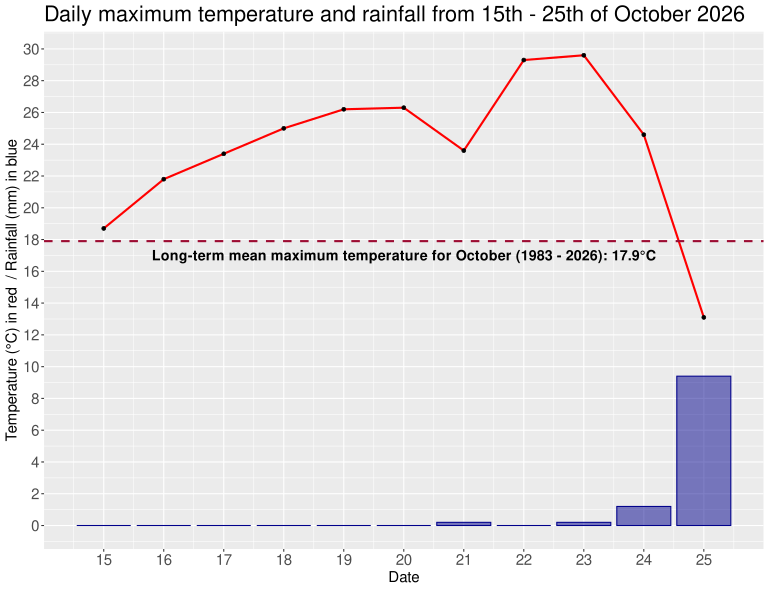
Initially I thought with all this recent hot weather (see graph here), this may cause the new recruits, who are still developing their root systems, to be under some water stress (not horrendous levels, but enough). Such water stress may even reduce the production of essential oils in the leaves, consequently providing ideal conditions for a psyllid outbreak to occur - or so my thinking was.
Eucs are rich in terpenoids such as 1,8-cineole, α-pinene, all these oils play a crucial role in plant defence from herbivory. To give a quote:
"One major role of cineole is to repel or intoxicate herbivores and insects. Many terpenes, like cineole and α-pinene, are small and hydrophobic, allowing them to penetrate insect tissues and interfere with nervous system functions."
The source of the quote and great detail on chemical defences in Eucs is here.
Fortunately, I fact-checked myself and discovered that I was wrong.
A 1994 paper researching the relationships between moisture stress and insect herbivory in Eucalyptus camaldulensis found that leaf concentrations of nitrogen and 1,8-cineole was independent of moisture (water) stress!
Their results discovered a couple things:
- Out of the natural oils found in E. camaldulensis 1,8-cineole is by far the most abundant terpinoid in the leaves (averaging 51% of total terpinoid yield).
- Leaves with a high cineole content had significantly less herbivory (but importantly is not correlated with moisture stress).
- They mentioned there may exist a threshold at which the leaves become vulnerable to insect herbivores.
- (Cineole content)/(total terpenoid yield) can vary signficantly between populations, ranging from 12.7% to 71.7%.
So did the population I observed have leaves with a low 1,8-cineole content?
Why then were all the recruits dying? The authors of this paper suggested the following:
"Plant moisture stress, however, was significantly correlated to resource availability (i.e. leaf size and abundance). In addition, our results support the conclusions of Landsberg (1989), that smaller eucalypt leaves sustain higher proportional damage from insect herbivory"
So it's possible having smaller (juvenile) leaves and not fully grown adult leaves meant the recruits were more susceptible.
But it's really a multitude of factors that allowed for a Psyllid outbreak to occur (some of which would be intrinsic to the particular Psyllid species). It's hard to have any conclusive statement as to the cause.
Back to my highway drive
I wanted to see the extent of this Psyllid outbreak, so I drove 5km down the road, to another patch of River Red Gums. Again all the young euc recruits had brown leaves and full of holes:
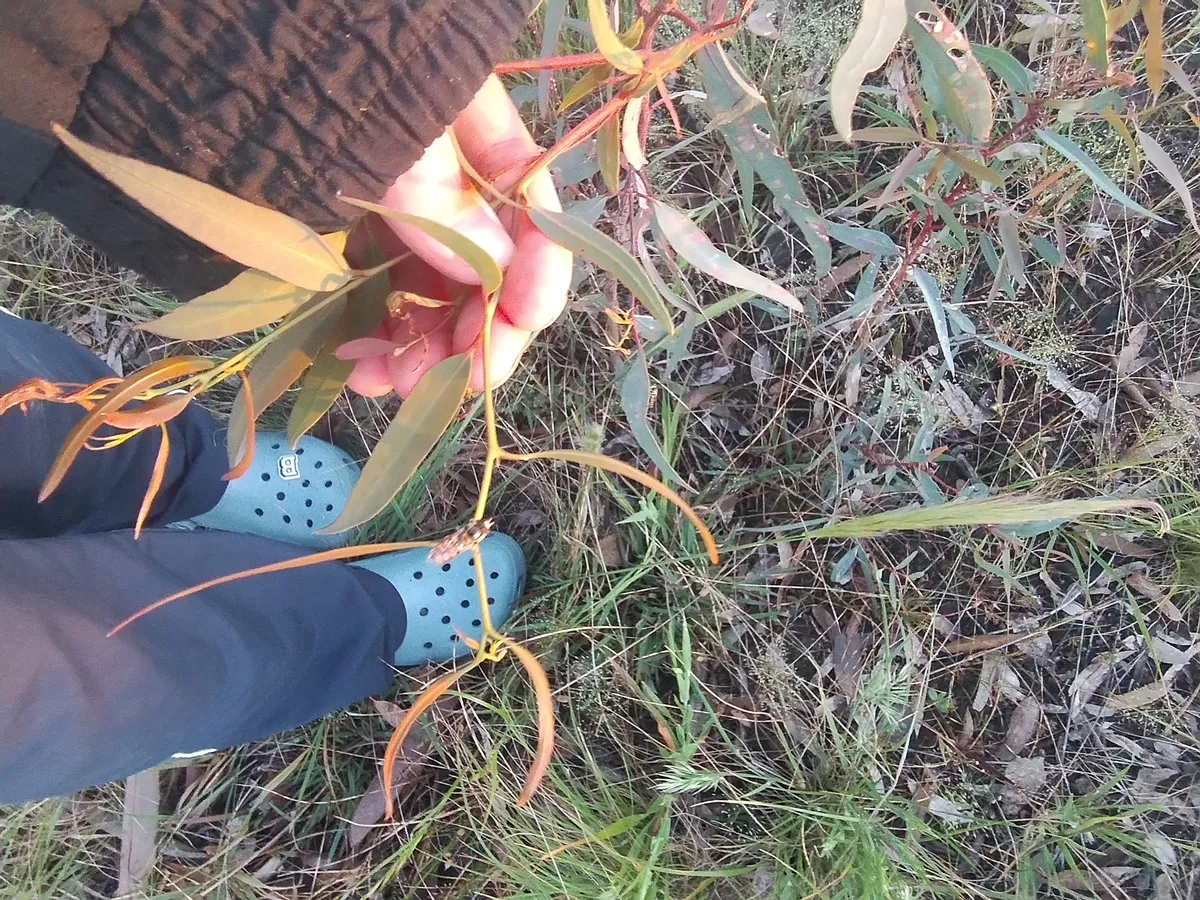
The patch I suspect had a slightly earlier outbreak of psyllids. All the leaves were mostly brown (not even red or purple). I was almost able to get a photo of an adult psyllid here :( It pains me, but my phone camera was just unable to focus on something this small (despite trying repeatedly):
 ...ignore the crocs.
You could tell it wasn't a hoverfly (as it somewhat resembles), it just looked different, especially in the head. I observed its own behavioural response to me. Most flies have a phenomenal reaction time. You cannot even get close without them taking flight. This one on the other hand, I could just about touch it and it did not seem phased by me at all. I am not sure if I can generalise this behaviour to all adult psyllids (probably not, given my sample size of one, for the whole of Psyllidae). However it was notable to me this behavioural response. The fact I could hold the tree, move it around a bit as I attempted to focus the camera and it still didn't move was strange but cool. It seems pretty chill.
It's the discovery of a world within a world that is awesome. In fact, the entire field of entomology is great for discovering these 'world within worlds'. There are so many species interactions going on here. I am left leaving with this perspective that is hard to describe.
Footnotes
Here is a graph of the daily maximum temperatures and rainfall over the 10 days preceding this observation (October 25th). All data was taken from the nearest weather station:
They are called 'meat ants' because farmers place animal carcasses on their mounds. The meat ants are able to devour it in weeks leaving nothing but bone! Insane.↩